
What if you could replace your $5,000/month marketing budget with $1,500 in lead spend, 30 minutes a week of review acquisition, and a quarterly content push — and end up with more booked customers, lower cost per acquisition, and zero agency invoices?
That is not a hypothetical. That is what the highest-performing pest control operators we work with are actually doing in 2026.
This post is the playbook.
Why traditional pest control marketing is breaking down
For 15 years, the standard pest control marketing stack looked like this:
- $2,000–$5,000/month to a marketing agency
- Another $3,000–$8,000/month in ad spend on Google + Meta
- A dedicated landing page (built every time you launch a new campaign)
- An SEO strategy (mostly invisible, hard to measure)
- Maybe Yelp Ads, Bark, Angi, HomeAdvisor on top
- Weekly status meetings with an account manager you mostly do not trust
It produced unpredictable results. Agencies sold tasks (ads, posts, blogs) instead of revenue. Owners saw activity but could not tie it to closed jobs. The math worked when CPCs were cheap and customer attention was easier to capture.
That world is over.
CPCs in pest control have doubled in major metros since 2022. Consumers do not trust ads anymore — they trust reviews. The “submit your info, we will get back to you” flow has been replaced by direct Google Maps clicks and AI-assisted recommendations. The 15-year-old marketing stack is solving for a market that no longer exists.
The new stack: three pillars, no agency, fraction of the cost
What is actually working for pest control companies in 2026 is dramatically simpler:
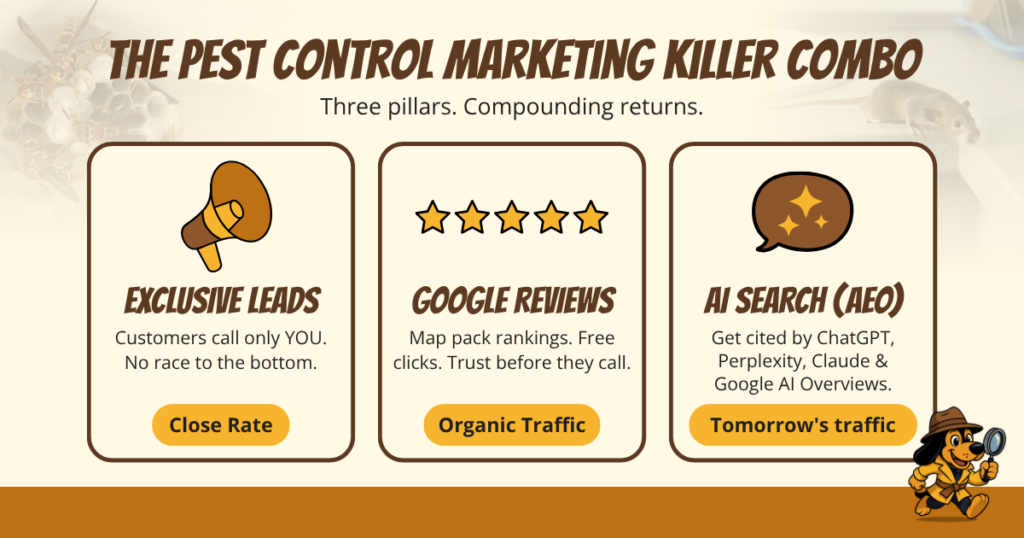
Pillar 1 — Pay-per-lead (the immediate revenue engine) Buy exclusive inbound calls and form leads from a network that generates demand for you. You pay per qualified lead from a wallet you control. Leads start flowing within days. No setup, no contracts, no marketing time required.
Pillar 2 — Google Business Profile + Review Velocity (the compounding organic engine) Optimize your GMB listing. Ask every customer for a review. Respond to all reviews within 24 hours. Stack up 50+ reviews in the first 90 days. Watch your “near me” Google Maps ranking climb. This is the single highest-ROI marketing investment for any pest control company in 2026 — and it costs almost nothing.
Pillar 3 — AEO + Niche Content (the AI search visibility play) AI assistants (ChatGPT, Perplexity, Gemini, Claude) are increasingly how customers find local services. Creating content optimized for AI extraction (clear FAQs, comparison pages, original data, definitional content) gets your business cited in those AI answers. It is SEO for the next 5 years, and almost no pest control company is doing it yet.
Combined, these three pillars deliver more booked customers than the traditional stack — at 30–40% of the cost, with 80% less time required from you.
Let us break down each one.
Pillar 1: Pay-Per-Lead — the immediate revenue engine
Pay-per-lead is the foundation because it is the only marketing channel that delivers revenue on day one. SEO compounds over months. Reviews compound over years. Pay-per-lead works the day your wallet is funded.
The right pay-per-lead model has three properties:
Exclusive routing. Every lead goes to one company only — yours. No sharing with 4 other contractors racing to call first. No undercutting on price.
You pay per qualified call or form — not per impression, not per click, not for spam.
Wallet-based, no contracts. You fund a deposit ($1,000–$5,000), each lead deducts from it, you can pause or refund anytime.
That is the whole model. There is no setup fee, no agency layer, no monthly retainer.
The math
A pest control company spending $2,000/month on exclusive pay-per-lead in a mid-sized market typically generates 15–30 qualified calls per month. At a 50–60% close rate (the typical exclusive-lead close rate), that is 8–18 closed customers per month at an average ticket of $250–$400.
Revenue: $2,000–$7,200/month from $2,000 in lead spend.
Compare that to a $2,000 Google Ads spend (managed by an agency you are also paying $2,000 to): you are at $4,000 in marketing cost producing roughly the same lead volume but with a 20–30% close rate (because customers are calling around to multiple businesses). Net: same revenue, double the cost.
Why pay-per-lead works as the foundation
Three reasons:
- It buys you time. While you build the slow-compound channels (reviews, content), pay-per-lead is filling your calendar today.
- It is measurable from minute one. You know exactly what each lead cost. You know exactly which closed. The math is clean.
- It scales with no operational change. Add $500 to your wallet, get more leads. Cut $500, get fewer. No campaigns to manage, no agency to renegotiate.
See custom pay-per-lead pricing for your city →
Pillar 2: Google Business Profile — the compounding organic engine
This is the single most overlooked, highest-leverage marketing investment in pest control.
Here is why GMB matters more than your website in 2026:
When a homeowner searches “pest control near me” or “exterminator [city],” Google shows the Map Pack first — three local businesses with stars, reviews, and a “Call” button. That Map Pack gets 40–60% of all clicks. Your website is below it. Most users never scroll past it.
Whether you appear in the Map Pack depends almost entirely on:
- Review count (more is better, with diminishing returns past 200)
- Review velocity (recent reviews matter more than old ones)
- Review response rate (Google rewards businesses that engage)
- Review keywords (when reviews mention “termite,” you rank better for “termite [city]”)
- Photos (real photos of your team and work outperform stock images)
- Posts (Google posts on your GMB are a small but real ranking factor)
- Q&A (you can pre-populate FAQs on your GMB)
- Service areas + categories (set these correctly)
None of these cost money. All of them require consistent attention. Most pest control companies do almost none of them.
The 90-day GMB sprint
Every pest control company should run this sprint at least once. It costs nothing and pays back permanently:
Week 1: Audit your current GMB. Check NAP (name, address, phone) consistency. Set service areas correctly. Add 8–12 photos of your team, trucks, and work. Add all relevant service categories.
Weeks 2–4: Set up a system to ask every customer for a Google review on the day of service. Three options:
- Email/SMS with direct review link 4–6 hours after service completion
- Tech hands customer a printed card with QR code linking to review form
- Owner personally calls high-value customers 24 hours after service to ask for review
Aim for a 15–25% review rate on completed jobs. If you do 100 jobs a month, that is 15–25 new Google reviews per month. Stack that for 90 days = 45–75 new reviews. That is enough to crack the Map Pack in most mid-sized cities.
Weeks 5–12: Maintain the cadence. Respond to every review within 24 hours (positive or negative). Post on your GMB weekly (a photo + caption is fine). Add new Q&A entries monthly.
By day 90, your Map Pack rankings should noticeably improve, and you will start getting “phone calls from Google” that cost you $0.
The killer combo: pay-per-lead + GMB working together
Here is the magic of this combo: pay-per-lead and GMB amplify each other.
When you get a customer through pay-per-lead, you ask them for a review. That review boosts your GMB ranking. As your Map Pack ranking climbs, you start getting free organic phone calls. Those organic customers become more reviews. Reviews → ranking → calls → reviews → ranking → calls.
After 6–12 months, your GMB is generating organic phone calls equal to or greater than your paid lead volume. You can either:
- Maintain the same paid spend and double your total calls
- Cut paid spend in half and keep the same total volume
Either way, your cost per acquisition drops by 30–50% year-over-year. Without doing anything different.
This is the compounding the agencies do not sell you on, because it makes their retainer harder to justify.
Pillar 3: AEO + niche content — the AI visibility play
Here is what almost no pest control company is doing yet — but the smart ones will be doing in 2027 and wishing they had started in 2026.
AI search is increasingly how consumers find local services. People ask ChatGPT, Perplexity, Gemini, and Claude things like:
- “What is the best pest control company in Phoenix?”
- “How do I get rid of bed bugs in a small apartment?”
- “What does termite treatment usually cost?”
- “Should I hire a pest control company or do it myself?”
The AI answers those questions by pulling from web content it is trained on or actively searching. Whoever content gets cited becomes the recommended source.
AEO (Answer Engine Optimization) is SEO for that world. The principles are different from traditional SEO:
- Comparison content gets cited heavily (“X vs Y vs Z”)
- Original data and stats get extracted (“the average cost of bed bug treatment is $X”)
- Structured FAQ pages get pulled directly into AI responses
- Definitional content (“What is integrated pest management?”) wins for educational queries
- Niche specificity beats broad authority (most pest companies write generic “pest control tips” — niche AEO writes “termite swarming season in Atlanta: what to do in the first 48 hours”)
The niche content strategy that compounds
Most pest control content marketing is wasted because it competes with HGTV, Forbes, and big national brands on broad terms. You will never out-rank Forbes for “how to get rid of ants.”
What you CAN win on is hyper-specific, high-intent queries that big publishers do not bother with:
- “Cost of carpenter ant treatment in [Your City] 2026”
- “Why my exterminator quoted $400 for bed bugs (what is actually fair)”
- “Termite vs flying ant: how to tell in 30 seconds”
- “Phoenix scorpion control: do glow lights actually work?”
These are 200–800 monthly searches each in most cities. Almost zero competition. High intent (someone searching this is about to call a pest control company). And AI engines love this kind of specific, factual, locally-relevant content.
Write 1 niche article per month. After 12 months you have 12 pieces of content quietly attracting high-intent traffic and being cited by AI search. Each one took 2–3 hours to write. Total annual cost: about 30 hours of your time (or $1,500 if you outsource to a writer).
Compare that to the $20K–$60K/year you would pay an agency for “SEO content” — that mostly produces generic posts no one reads.
What “AI-friendly” content actually looks like
Five concrete patterns AI engines reward:
- A clear FAQ section at the bottom with structured Q&A pairs
- A comparison table somewhere in the post (X vs Y on multiple dimensions)
- Specific numbers in headers (“$400 termite treatments” not “expensive termite treatments”)
- Original case study or data point (one real outcome from your business)
- Definitional content that directly answers a “what is X” or “how does X work” query
Use those patterns and your content gets cited disproportionately by AI engines. Skip them and you are invisible regardless of how good the writing is.
How to combine all three: the 30-day plan
Here is what a pest control company should actually do in their first 30 days running the killer combo:
Days 1–7 — Set the foundation
- Apply for pay-per-lead pricing in your city (here)
- Audit your Google Business Profile — fix NAP, add categories, add photos
- Set up a simple review request system (email/SMS to every customer post-service)
Days 8–14 — Activate
- Fund your pay-per-lead wallet, leads start flowing
- Launch your GMB review request system
- Pick your first niche article topic (something specific to your city + a high-value pest category)
Days 15–21 — Operate + compound
- Answer every pay-per-lead call within 5 minutes
- Send review requests to every closed customer
- Respond to every Google review within 24 hours
- Write your first niche article
Days 22–30 — Measure + iterate
- Calculate your cost per closed customer from pay-per-lead
- Count new GMB reviews from the month
- Publish your first niche article
- Plan next month article topic
By day 30, you have a working revenue system that costs maybe $2,500/month total (most of it actual lead spend, none of it agency retainers). Most pest control owners running the traditional stack are paying 3–5× that for worse results.
What this saves you
Let us compare 12-month total cost of the traditional stack vs the killer combo, for a typical $750K pest control business:
| Cost line | Traditional stack | Killer combo |
|---|---|---|
| Marketing agency retainer | $42,000 ($3,500/mo) | $0 |
| Google Ads management | (included in retainer) | $0 |
| Meta Ads management | (included in retainer) | $0 |
| Ad spend | $36,000 | $0 (pay-per-lead replaces) |
| Pay-per-lead | $0 | $24,000 ($2K/mo) |
| Marketing software | $2,400 | $600 (review tools only) |
| Content writer | $0 | $1,800 (1/mo at $150) |
| Your time | 80 hrs/year (meetings, oversight) | 30 hrs/year (writing, GMB) |
| Total | $80,400 + 80 hrs | $26,400 + 30 hrs |
You save $54,000 + 50 hours per year. And you typically end up with more booked customers, not fewer.
Why this works specifically for pest control
Three industry-specific reasons the killer combo works better for pest control than other home services:
- Pest control has high local-search intent. When pests appear, customers Google immediately. GMB Map Pack visibility converts at 25–40% (vs 3–8% for general web traffic). You are catching demand at peak intent.
- Pest jobs convert to recurring service. A one-time rodent treatment becomes a monthly service contract. A termite job becomes an annual warranty renewal. The lifetime value per booked customer is way higher than industry averages — meaning even slightly higher marketing costs are easily justified.
- Pest content opportunities are massive but mostly untapped. Unlike plumbing or HVAC where Forbes has covered every topic, pest control niches are wide open. You can rank for “scorpion control [city]” in 60 days because no major publisher cares about that query. AI engines reward you for being the only authoritative source.
The bigger picture
The pest control marketing industry has spent 15 years convincing owners they need expensive, complex systems. Most of those systems were built to justify agency retainers — not to serve the actual buyer.
In 2026, the simpler stack wins. Less software. Fewer agencies. Less marketing jargon. More direct connection between marketing dollars and closed customers.
The owners who switch first will compound advantages: better GMB rankings, more AI-citation content, lower cost per acquisition. By the time the rest of the industry catches up, the early movers will own the local Map Pack and own the AI recommendations for their categories.
You do not need to figure all this out alone. Pay-per-lead is the on-ramp — it gives you predictable lead flow while you build the GMB and AEO compounding engines.
Related reading
- Why Pest Control Companies Are Burning Money on Bark, Angi & HomeAdvisor — the actual math behind shared lead platforms
- The Real Cost of Pest Control Marketing in 2026 — agency vs DIY vs pay-per-lead breakdown with real ROI math
Frequently asked questions
What is the best marketing strategy for pest control companies in 2026?
The highest-ROI marketing strategy combines three pillars: exclusive pay-per-lead (immediate revenue), Google Business Profile + review acquisition (compounding organic visibility), and AEO-optimized niche content (AI search visibility). This combo replaces traditional agency-led marketing at roughly 30% of the cost while typically delivering more booked customers.
How important is Google Business Profile for pest control?
GMB is the single highest-leverage marketing investment for pest control companies in 2026. The Google Map Pack (which displays the top 3 local businesses with reviews and a “Call” button) gets 40–60% of all “pest control near me” clicks. Map Pack ranking depends primarily on review count, review velocity, and review response rate — all of which cost almost nothing to optimize.
What is AEO and why does it matter for pest control?
AEO (Answer Engine Optimization) is the practice of structuring web content so AI assistants like ChatGPT, Perplexity, Gemini, and Claude cite it when answering user questions. AI search is increasingly how consumers find local services, and pest control companies that publish AEO-optimized content (FAQs, comparisons, original data, niche topics) get recommended in AI answers — without needing to run ads or rank #1 on Google.
How many Google reviews does a pest control company need?
Aim for 50+ reviews to start ranking competitively in the Google Map Pack in most mid-sized cities. 100+ for major metros. Beyond 200 reviews, returns diminish (going from 200 to 400 does not dramatically change ranking). What matters more after the initial volume is review velocity (consistent new reviews) and response rate (responding to all reviews within 24 hours).
Can I run pest control marketing without an agency?
Yes — and increasingly the math favors not having an agency for pest control companies under $2M in revenue. The combination of pay-per-lead (no marketing time required), GMB optimization (30 minutes/week), and quarterly niche content typically delivers better ROI than a $2,000–$5,000/month agency retainer. The exception is multi-location pest control businesses doing $2M+ where strategic complexity justifies a dedicated marketing team or agency.
How long does it take for the killer combo to work?
Pay-per-lead generates revenue starting week one. GMB review acquisition starts compounding around 60–90 days as new reviews accumulate. AEO content starts ranking and being cited in AI search around 90–180 days as Google indexes the content and AI engines update their knowledge bases. The full compounding effect (where organic GMB calls + AI-recommended traffic exceed paid lead volume) typically hits at month 9–12.
Ready to start with the foundation? Apply for exclusive pay-per-lead pricing in your city — 90-second application, custom quote within 4 business hours. We will have you running the immediate-revenue pillar this week. The GMB and AEO compounding can start the same day — and within 12 months, you will have a marketing system that prints money while you focus on running the business.